
God created the earth and everything in it (Psalm 24:1–2). He also created humanity—male and female—from the dust of the ground and entrusted the earth to them as their domain (Genesis 1:26–28; 2:7). In Psalm 115:16, the psalmist affirms this stewardship: “The heavens are the Lord’s heavens, but the earth He has given to the children of man.” God granted humans dominion over His creation, placing all things under their feet—livestock, beasts of the field, birds of the air, and fish of the sea (Psalm 8:6–8).
While God reigns sovereign over all creation, He ordinarily allows the natural order to function without constant supernatural interruption. Yet at various points in redemptive history, He has intervened through what Scripture calls signs and wonders—acts in which God suspends or overrides natural processes for His glory. The exodus narrative is filled with such miracles: the ten plagues, the parting of the Red Sea, the destruction of Pharaoh’s army, the parting of the Jordan River, and God’s supernatural provision and protection in the wilderness (Exodus 7–14; Joshua 3). Scripture also records miracles such as the raising of the dead, the mute speaking, the deaf hearing, the blind receiving sight, the multiplication of food, and even walking on water (1 Kings 17:22; Isaiah 35:5–6; Matthew 14:25).
Jesus performed miracles to reveal His divine identity as the Messiah and to confirm His authority so that many would believe in Him. The Gospel of John calls these works signs because they point beyond themselves to the truth of who He is (John 20:30–31). His miracles displayed both His compassion for human suffering and the inbreaking of God’s kingdom—His authority over sickness, nature, demons, and death. On witnessing these miracles many praised God while others like those who saw Christ calm the storm were compelled to ask, “What sort of man is this, that even the winds and the sea obey him?” (Matthew 8:27).
With the earth placed under human stewardship, we have used our God‑given creativity to innovate in ways that have significantly improved quality of life. Humanity has built residential and commercial structures, developed transportation networks, engineered mechanized systems for farming, and advanced technologies that support communication, commerce, and education. Medical science has progressed dramatically, producing treatments, vaccines, and surgical techniques that have extended life expectancy and reduced mortality from once‑fatal diseases. These developments reflect the remarkable capacity God gave humanity to cultivate, build, and subdue the earth in constructive ways.
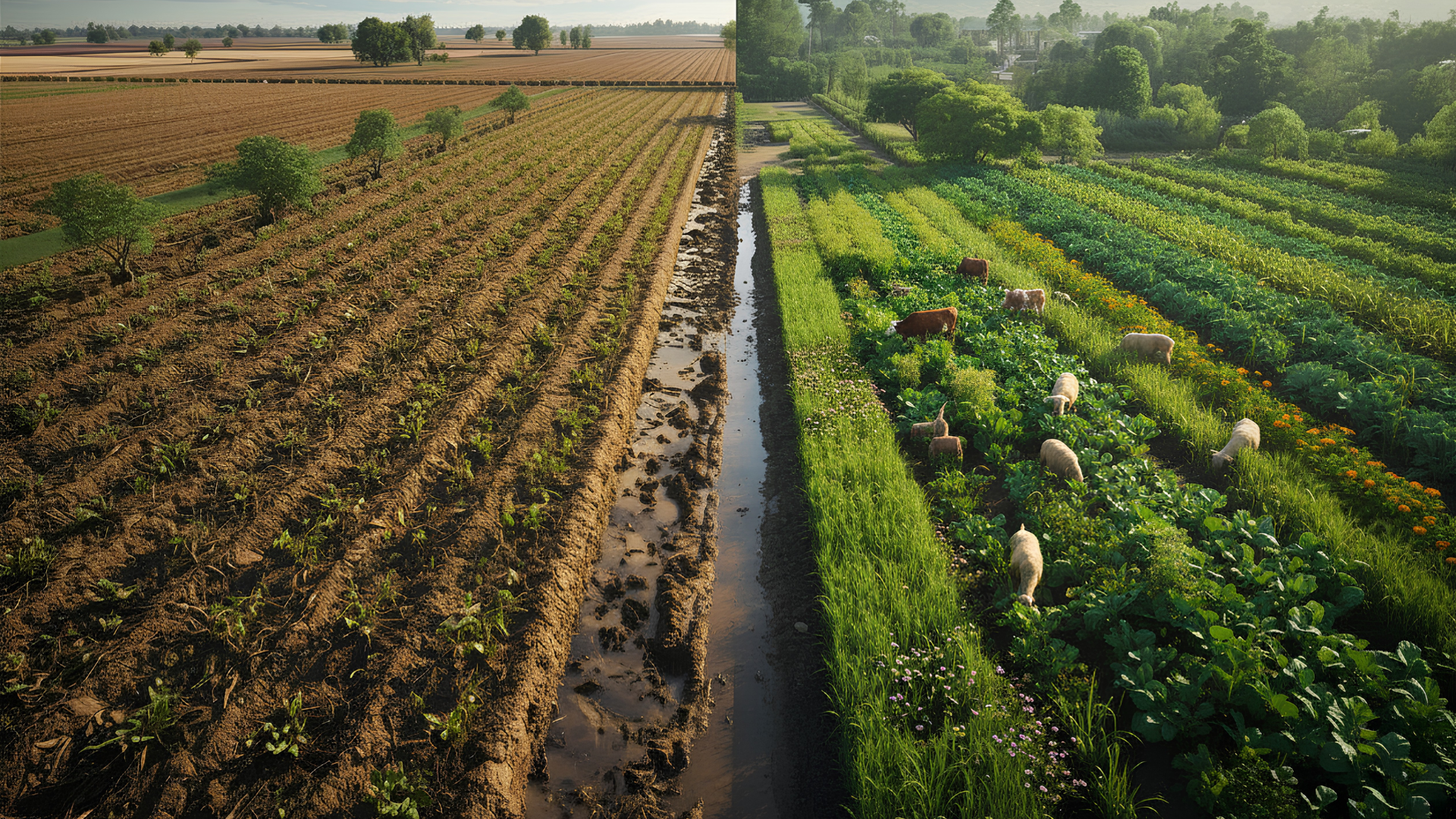
Yet alongside these achievements, human activity has also inflicted profound damage on the earth and on one another. Modern agricultural practices—especially intensive tillage, monoculture farming, and heavy reliance on synthetic fertilizers—have depleted soils worldwide. Research shows that 1.6 billion hectares of land are now degraded due to human activity, with over 60% of that damage occurring on cropland and pastureland (Science Insights, 2026). This degradation reduces fertility, weakens ecosystems, and threatens long‑term food security.
Environmental harm extends beyond soil. Industrial farming, deforestation, pollution, and overgrazing have contributed to widespread land degradation, with over 70% of the earth’s land altered by human activity (UN Environment Programme, 2024). These pressures diminish biodiversity, accelerate erosion, and destabilize water systems. Chemical overuse—including pesticides, herbicides, and fertilizers—further burdens ecosystems and can contaminate waterways, affecting both wildlife and human health.
Beyond environmental damage, human governance and conflict have caused immense suffering. Wars, genocides, political oppression, and economic exploitation have left millions dead and many more displaced or impoverished. Manmade catastrophes—whether through negligence, corruption, or violence—continue to shape global patterns of suffering.
We have built, healed, and innovated; yet we have also depleted, polluted, and destroyed. This naturally leads us to ask: Why doesn’t the sovereign God who created the earth intervene to correct everything? Scripture suggests that God allows this tension so we might understand essential truths: the brokenness of the world after sin entered it, our own limitations, and the need for everything to be made new.
The Need For The Restoration Of All Things
Scripture teaches that sin entered the world through one man, and through that one act of disobedience, death and corruption spread to all humanity (Romans 5:12). All the brokenness we see—moral, relational, physical, and environmental—traces back to Adam’s rebellion in Eden. In the aftermath of the fall, God Himself provided garments of animal skin for Adam and Eve, implying the first death in creation and foreshadowing the costliness of covering sin (Genesis 3:21).
The consequences of sin reshaped every dimension of life. The ground was cursed, making human labor painful and burdensome (Genesis 3:17–19). Women were told they would experience pain in childbirth (Genesis 3:16). Human beings, once destined for unbroken fellowship with God, became subject to death and would return to the dust from which they were made (Genesis 3:19). Violence soon followed, as Cain killed his brother Abel (Genesis 4:8), and the earth became filled with corruption and bloodshed (Genesis 6:11–12). The world we inhabit today still bears the marks of that ancient fracture.
Scripture also reveals that the devil—“the god of this world” and “the prince of the power of the air”—blinds the minds of unbelievers, preventing them from seeing the light of God’s truth (2 Corinthians 4:4; Ephesians 2:2). This spiritual blindness, combined with the brokenness of creation, confronts us with our limitations. We learn that our supposed “goodness” cannot make us righteous before God, for “all our righteous deeds are like filthy rags” (Isaiah 64:6). Though we were entrusted with stewardship over the earth (Genesis 1:26–28), we are not sovereign over it. Our inability to heal the world’s deepest wounds reveals the destructive power of sin and the damage we have inflicted on creation (Romans 8:20–22).
This awareness awakens in us a longing for restoration—a recognition that the world is not as it should be and cannot fix itself. We begin to understand that the brokenness around us and within us points to a greater need: the need for all things to be made new. And the question naturally arises: Who can restore what sin has shattered? Scripture’s answer is clear—only God, the Creator of all things, can redeem and renew what has been lost (Revelation 21:5).
God’s Great Intervention
Being rich in mercy, God made the most significant intervention in human history when He gave His only Son, Jesus Christ, to accomplish what humanity never could (John 3:16; Ephesians 2:4–5). It is a miracle of grace that the eternal Son of God would humble Himself, take on human flesh, and enter His own creation (Philippians 2:6–8; John 1:14). The incarnation is the supreme demonstration of God’s love, humility, and redemptive purpose.
Christ came to save people from their sins by grace through faith (Ephesians 2:8–9). Through His death and resurrection, He defeated death and secured eternal life for all who believe in Him (2 Timothy 1:10; John 11:25–26). His victory over sin and death is not only personal but cosmic. Because of Christ, the rest of creation—which now groans under corruption—has hope of future liberation and renewal (Romans 8:18–23).
In Christ, God has begun the restoration of all things. The incarnation, the cross, the resurrection, and the Parousia together form the centerpiece of God’s redemptive plan: the restoration of humanity and the renewal of the entire created order.
What Does Christ Make New?
When Jesus declares, “Behold, I am making all things new” (Revelation 21:5), He is announcing the total renewal of everything touched by the curse. By “all things,” Christ refers to the entire created order—heaven, earth, and His redeemed people. Nothing in creation that has been subjected to decay will remain unchanged when Christ completes His work of restoration.
Christ Makes Our Bodies New
Scripture teaches that “flesh and blood cannot inherit the kingdom of God, nor does the perishable inherit the imperishable” (1 Corinthians 15:50). Our present bodies, weakened by sin and subject to death, are unfit for the glory of God’s eternal kingdom. But at His second coming, Christ will transform our lowly bodies to be like His glorious body (Philippians 3:20–21). The mortal will put on immortality, and death—once the great enemy—will be swallowed up in victory (1 Corinthians 15:54–55).
In the new creation, God will wipe away every tear from the eyes of His people. Death will be no more. Mourning, crying, and pain will vanish forever, for the former things will have passed away (Revelation 21:4). The tree of life, once guarded in Eden, will again be accessible, bearing twelve kinds of fruit and providing healing for the nations (Revelation 22:2). Christ Himself will be the everlasting life and immortality of His people (2 Timothy 1:10).
Christ Makes A New Heaven And A New Earth
Christ’s renewal extends beyond our bodies to the entire cosmos. On the day of the Lord, all human works—both the good and the destructive—will be exposed and then burned up, purified by divine fire (2 Peter 3:7, 10). The earth, long burdened by corruption, pollution, and decay, will be remade.
Then Christ will bring forth “a new heaven and a new earth in which righteousness dwells” (2 Peter 3:13). John saw this reality in his vision: the first heaven and the first earth had passed away, and in their place stood a renewed creation free from every curse (Revelation 21:1; 22:3). In this new world, God and Christ will dwell with the saints, and nothing unclean or accursed will ever enter it.
Christ Is The New Temple
In ages past, God dwelt in temples made by human hands. Under the new covenant, He dwells in His people through the Holy Spirit (1 Corinthians 3:16; 6:19). But when God makes all things new, even this arrangement will give way to something greater. In the New Jerusalem—the perfected Church—there will be no temple built by human hands and no temple made of human bodies. “Its temple is the Lord God the Almighty and the Lamb” (Revelation 21:22). God Himself will be the dwelling place of His people, and His people will be His dwelling place forever (Revelation 21:3).
When God makes all things new, the contrast between the old and the restored will be unmistakable. All people will see the difference between what has fallen and what has been gloriously made new. The brokenness of the present age will give way to the wholeness of the age to come. What sin has marred, Christ will perfect. What death has claimed, Christ will restore. What creation now groans for, Christ will fulfill (Romans 8:19–23).
What Sort Of People Ought We To Be?
Knowing the fate of all existing things, Scripture presses a deeply practical question upon us: What sort of believers ought we to be? If everything in this present world is destined to pass away, then our lives must be shaped by the hope of what God has promised. Peter teaches that because the heavens and the earth will be dissolved, we must live holy and godly lives as we wait for the coming of the Lord (2 Peter 3:11–12). Our hope in God’s future work should produce present obedience.
We are called to live diligently in Christ so that when He returns, He finds us faithful—busy doing His work, walking without spot or blemish, and living at peace with God and with one another (2 Peter 3:14). The believer’s life is not one of passive waiting but active readiness, marked by purity, devotion, and steadfastness.
Some may interpret this long period before God makes all things new as a sign of failure or delay. But Scripture teaches the opposite. Christ must remain in heaven—where He is now seated at the right hand of the Father—until the appointed time for the restoration of all things (Acts 3:19–21; Hebrews 1:3; Colossians 3:1). The apparent delay is not neglect; it is divine purpose. The patience of the Lord is directed toward salvation. He is “not wishing that any should perish, but that all should reach repentance” (2 Peter 3:9). What seems slow to us is actually mercy, giving space for sinners to hear the gospel, repent, and be converted (Acts 17:30; 2 Peter 3:15).
Until the restoration of all things, we must remain faithful. The God who promises to make all things new is not a man that He should lie (Numbers 23:19). His word is sure, His timing is perfect, and His purposes cannot fail. Therefore, we live with confidence, holiness, and hope—knowing that the One who calls us is faithful, and He will surely do it (1 Thessalonians 5:24).
Amen.
References
Science Insights. (2026, March 10). What is soil depletion: Causes, effects, and fixes. Retrieved from https://scienceinsights.org/what-is-soil-depletion-causes-effects-and-fixes/?utm_source=copilot.com
UN Environment Programme. (2024, December 5). Five reasons why soil health is declining worldwide. Retrieved from https://www.unep.org/news-and-stories/story/five-reasons-why-soil-health-declining-worldwide
